
From almost anywhere in the city, you can look up and see it. Prague Castle sits on a massive hill, looming over the river and the red roofs below. It looks like something out of a dark fairy tale.
Location: Malá Strana to Prague Castle
Time: 02:00 PM
Vibe: A medieval workout
Mood: Out of breath but triumphant Soundtrack: Heavy breathing and distant church bells
But what the postcards don’t show you is the physical reality of getting up there. You can take the tram up the back side of the hill, but that feels like cheating. I wanted to earn the view. So, I crossed the river into Malá Strana and stood at the bottom of Nerudova Street.
The Cobblestone Mountain
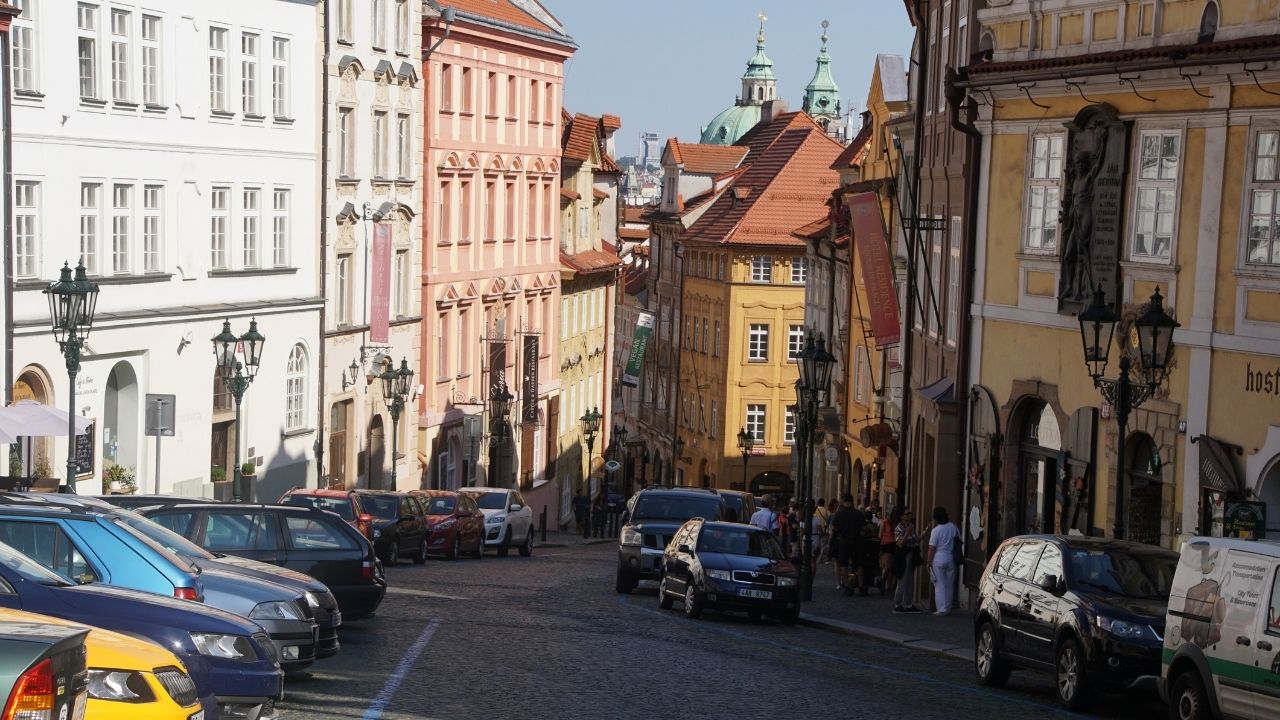
Nerudova Street is stunning. It is a narrow, winding road lined with perfectly preserved Baroque buildings painted in pastel colors. But it is also incredibly steep. And like almost everything in the historic center, it is paved with uneven, rounded cobblestones.
I started the climb. By the time I passed the first few historic pubs and souvenir shops, my calves were already burning.
Before house numbers were invented, people in Prague identified their homes using signs carved above the doorways. To give myself an excuse to stop and catch my breath, I started looking for them. I paused in front of the “House of the Two Suns,” then the “Red Eagle,” and then the “Golden Horseshoe.” I was pretending to be deeply interested in the architecture, but really, I just needed oxygen.
The Gothic Shock (St. Vitus Cathedral)
After what felt like an hour (but was probably only 20 minutes), the street leveled out. I passed the serious-looking palace guards at the main gate and walked into the castle complex.
Prague Castle isn’t just one building; it’s a massive walled city. I walked through the first two courtyards, catching my breath. Then, I stepped through a stone archway into the third courtyard and stopped dead in my tracks.
Nothing prepares you for St. Vitus Cathedral. Because the courtyard is so small and the cathedral is so impossibly huge, you cannot even see the top of it without bending your neck completely backward. It is a masterpiece of dark, aggressive Gothic architecture. The black, weathered stone is covered in sharp spikes, jagged spires, and terrifying gargoyles looking down at you. It is so massive and overwhelming that it actually makes you feel physically small.
The Reward
I didn’t go inside the cathedral right away. My legs needed a break. I walked to the southern wall of the castle complex and looked back over the ledge.
From up here, the entire city of Prague was spread out below me. I could see the Vltava River cutting through the middle, the Charles Bridge crawling with tiny dots of tourists, and thousands of burnt-orange terracotta roofs glowing in the afternoon sun.
The Verdict
Climbing Nerudova Street is a rite of passage. If you have bad knees, absolutely take Tram 22 to the top and walk down. But if you are physically able, you have to do the climb. The scale of the castle and the cathedral hits you so much harder when you have spent half an hour fighting gravity to get there.
My “Eat Walk Repeat” Note for Today:
Eat: Do not eat a heavy Czech meal before this climb. Save the goulash for dinner as your reward.
Walk: To save your knees on the way back, do not walk down Nerudova. Take the Old Castle Stairs (Staré zámecké schody) on the eastern side. It drops you right by the Malostranská metro station.
Repeat: Actually look up at the doorways on Nerudova Street. The house signs (like the Golden Key or the Three Fiddles) are fascinating pieces of medieval history.